Together Tip: Preview Zip Files

November 30th, 2007 by Steve Harris

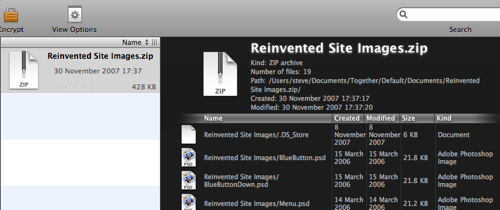
Together’s use of Quick Look previews are really handy, allowing you to see preview documents you wouldn’t normally be able to see without opening another application or using the Finder.

As you may know, any delevoper can create a Quick Look generator for their file format, or in the case of this one, for a generic format not covered by Leopard’s built-in generators.

A developer, known as xdd, and a designer, Taiyo, created a Quick Look generator for ZIP files, which will also work in Together.

together_zipfiles

This is the great thing about Together now – any file you can preview with Quick Look, you can also view in Together. I think it is the only non-Apple app to show previews in its own interface right now.

Together Tip: Watched Folders

November 28th, 2007 by Steve Harris

Note: The ability to automatically import files added to Together’s library folders was added in Together 2.1 – See Together 2.1 – New Ways to Import for more information.

I’ve had a few requests for watched folders in Together, the idea being that you can save a file in a folder and it is automatically imported into Together.

This approach will also work well for scanned documents and the good news is you don’t have to wait for me to clear my email deluge and get back to some development, you can do this with a little Automator. Here’s how:

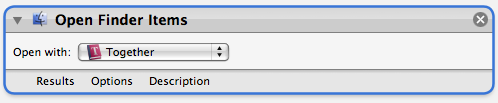
Any file opened in Together will automatically be added to the library, so all you need is a simple Automator workflow, with one action in it, like this:

Open in Together Automator action

Here’s one you can download: OpenInTogether.zip (26KB)

To use it:

  • Uncompress the file and open it in Automator.
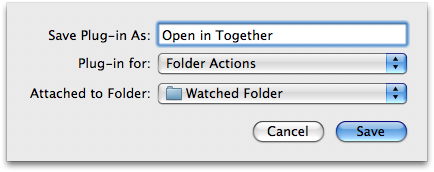
  • Choose File > Save As Plug-in from the menu.
  • From the “Plug-in for” pop-up choose “Folder Actions”
  • From the “Attached to Folder” pop-up, choose the folder to watch.
  • Click Save.
Saving automator action as a plug-in

After that, any files saved or moved into that watched folder will then be imported into Together.

Give Good Food to your Mac

November 27th, 2007 by Steve Harris

A group of European Mac developers have teamed up to bring Mac users a tasty new experience called Give Good Food to your Mac.

Give Good Food to your Mac logo

Running from today until December 8, Mac users can download and taste more than 25 great Mac applications and enjoy discounts ranging from 30% to 70%.

As this is haute cuisine, you can choose the exact ingredients. The more apps you buy, the bigger the discount on the full price of the apps. So, buying 3 apps you can save 30%, 5 apps 40%, 7 apps 50%, up to the maximum discount of 70% on 10 or more applications.

This promotion includes a stunning collection of high-quality applications from Aquafadas, Belight, Boinx, Cheetah3D, Coladia, Creaceed, Equinux, Iospirit, Jumsoft, Kletel, MacRabbit, Objective Decision, Ovolab, Pixelmator, ProjectWizards, Realmac Software, Softpress and your very own Reinvented Software.

The kitchen will remain open until the 8th of December, and on that note I’d better sign off before cooking up (haha!) any more food-related puns.

Bon appetite!

(Sorry)

Together 2.0 – User Interface

November 24th, 2007 by Steve Harris

This is the last in a series of posts highlighting some of the new features and improvements in Together 2.0, formerly known as KIT.

One of the most rewarding things about developing KIT is the number of compliments it received for its simplicity. When I first designed it, many apps of its kind were weighed down with interfaces full of clutter. I wanted the antithesis of that.

If you are a KIT user that hasn’t been able to use Together yet, with everything written so far you could worry that KIT’s simplicity will be lost. However, it has been my goal from the outset to maintain the simplicity while improving the overall experience. KIT users will find Together looks brand new yet reassuringly familiar.

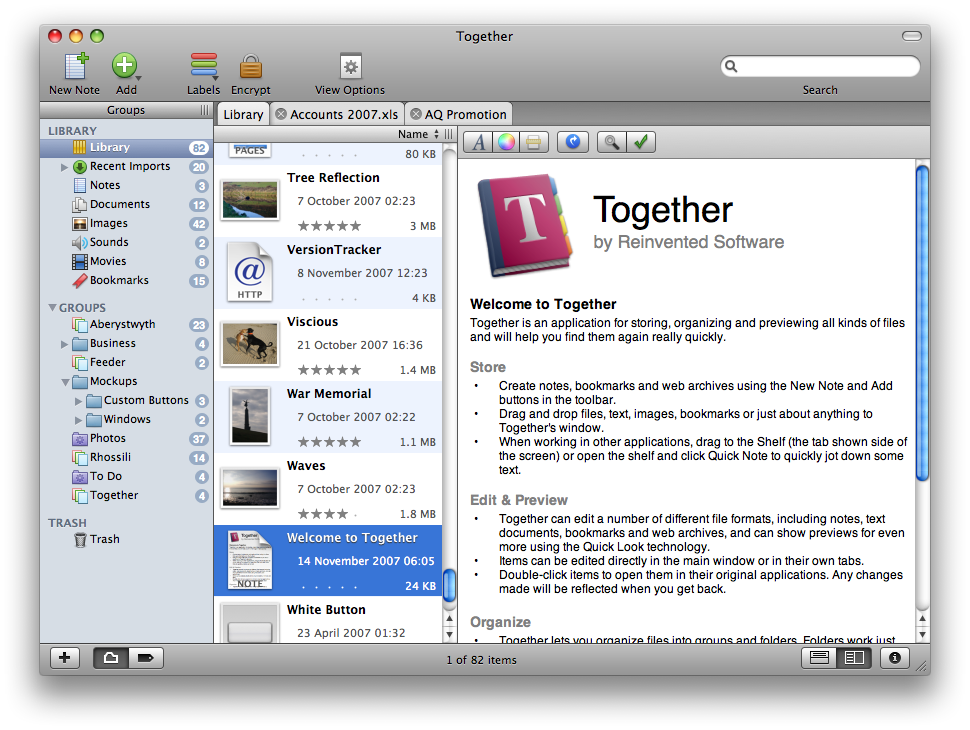
Very little has been added to the interface. The toolbar now includes an Encrypt button, while the Info button has moved to the status bar at the bottom of the window. The status bar contains two new controls. On the left, is a control to switch between the groups outline and the new tag browser. And on the right…

Portrait View

Most screens on today’s Macs use a widescreen format. To make the most of this, Together now has a portrait preview mode. In my testing, I found both portrait and landscape previews to have their uses, so you can switch between them easily. Here’s how the portrait preview looks (click for a bigger version):

Together Portrait View

In portrait view, the file list shows thumbnail icons with all the information alongside. The traditional columns don’t work well in portrait mode for obvious reasons. This way you can see about the same number of items and information about them as the landscape preview. Together uses Leopard’s Quick Look technology to generate thumbnails for most documents.

To make the most of the space in this mode, the Info view appears below the preview and each section gets its own tab. With the Info button now located in the bottom right, it’s more convenient to show or hide the Info view as needed. The thumbnail format ensures most information can be seen in the item list.

Tabs

As mentioned before, Together allows documents to be edited in the main window, and can edit file formats other than its own notes. Together uses a tabbed interface for editing multiple documents. This keeps things uncluttered and removes any confusion between documents open in Together and in other applications.

Of course, you can still edit documents in their original applications and there are preferences and modifier keys that can be used to determine what happens when items are double-clicked.

Shelf

KIT had a number of ways to import data from other applications, but each had some sort of drawback. Dragging to the groups list gave the best results, but the window had to be visible. The Services menu is buried and its nature imposes restrictions on the types of data it could properly handle, as did dragging to the Dock icon.

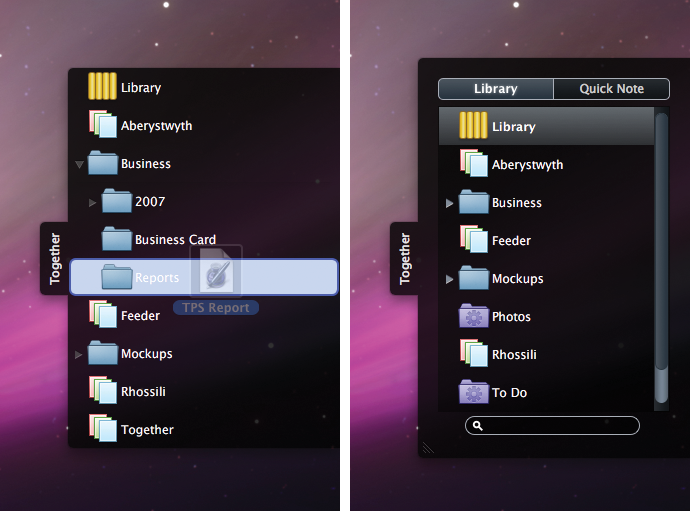
In Together, the answer is the Shelf, which appears as a tab on the side of the screen. Drag files or data here and a window will slide out with a list of groups and folders that can accept new items. Once the drag ends, the window slides back. However, unlike anything you have seen before, the Shelf has a few tricks up its sleeve.

Together's Shelf

Click on the tab to open the window and you’ll see groups and a search box. In this mode, the Shelf acts as a global browser for your library where you can browse groups, drag files to other applications and search. Files can also be opened in their applications or in Together, and you can also drag URLs, text or anything else to the Shelf, just as in Together’s main window.

The Shelf also has a Quick Note view. Here you can quickly enter a note without leaving the current application. The Shelf can also be opened in either mode using hot keys that work both within the app any in other application. The Shelf can reside at the top, middle or bottom of either side of the screen.

That’s It

That’s all for now. I originally wrote these posts for the run-up to releasing Together. My aim was partly to show off the app but also to answer some questions in advance, in the hope it would save me some support emails! 😀 However, events took over and I decided to save them until after the release. I’ve received some good feedback on these, so I’ll aim to post more tips in the future. Thanks for reading.
Together 2.0 – Data Management

November 23rd, 2007 by Steve Harris

This is the fifth post in a series highlighting some of the new features and improvements in Together 2.0 – formerly known as KIT.

So far we’ve covered lots of functionality you can see, such as how files can be organized, edited and viewed. This post is about some of the things you can’t see.

Encryption

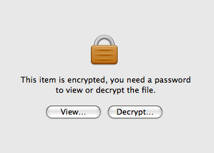
together_encryptFirstly, things you don’t want other people to see: Together can now encrypt files. Click the Encrypt button in the toolbar, enter a password and Together will encrypt the file or files and store the data in its database.

Once encrypted, you can either view the file temporarily or decrypt it entirely. Both operations will require the password. Be aware that if you forget the password, you won’t be able to open the file.

Core Data

Together uses Apple’s Core Data technology for its database. The original document files remain on disk as before, but Together now has a robust, high-performance database keeping track of them all.

If one thing that surprised me in feedback emails about KIT, it was the number of files people would put in it. Emails along the lines of “I just imported 10,000 files into KIT and it’s slowed to a crawl” left me unsure whether to laugh or cry. I designed KIT to be good for about 1,000 items although I heard of people who managed with more than that. You may think I was naive but I never expected people to dump everything into it, as its design (e.g. no hierarchical folders) discouraged that.

KIT didn’t keep much data about files, using the file system for most it, but indexing and sifting through those for things like smart groups could seriously slow things down. If you had thousands of files or some complicated smart groups, KIT’s could grind to a halt. Now performance for large volumes of data is much improved.

Together is a very “live” application and needs to react in many ways to changes in its data (e.g. by updating smart groups). People expect those reactions to be instantaneous. However, reacting to changes instantly is much less efficient than batching them together, especially as one change can often trigger others. Together has been designed to group changes together and is much more responsive as a result.

With performance though, there’s always room for improvement and I’m working on some of those right now.

Multiple Libraries

With KIT, you could store your KIT library in different places to the default and this became a workaround for having multiple KIT libraries. However, it was clumsy to use for that purpose. Together comes with a Library Manager for creating and switching between different libraries. Find it in the Together menu.