July 25th, 2008 by Steve Harris
ThinkMac Software released iKanji 1.0 yesterday. iKanji is an application for learning Japanese kanji characters on the Mac. iKanji is a companion application for iKana, which helps you learn Hiragana and Katakana.
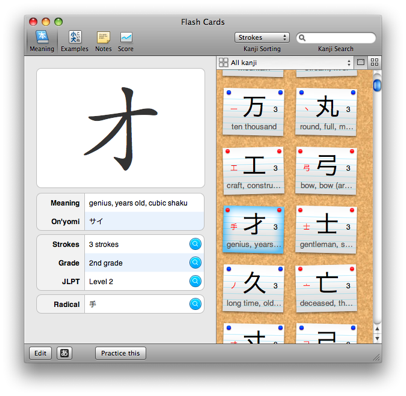 ThinkMac developer Rory Prior is a friend of mine (hence the plug) so I got to try iKanji before its release. I’m not learning Japanese and normally wouldn’t feel comfortable writing about such applications, but both iKanji and iKana are clearly exceptional learning tools. I’ve learned so much just trying them out.
Both applications are a superb example of usability on the Mac, look great, and include the sort of thoughtfulness that surprises and delights without ever being gimmicky or patronising. Also, to my surprise, they are a lot of fun.
iKanji’s learning experience is focused around flash cards and includes 2230 kanji built-in, with the ability to add your own, and nearly 20,000 example words. It can also search by kanji, meaning, radical and examples, sort kanji by stroke count or radical, allows you to add your own notes and create your own practice sets. iKanji covers Japanese school grades 1 to 6, JLPT levels 1 to 4 and 214 kanji radicals.
Following on from that are the tests. iKanji has tests for meanings, reading and writing (complete with animated stroke animations). After taking the tests, you’ll be able to see your proficiency with gold, silver and bronze stars marked on the kanji and plotted on a graph to see your performance over time.
iKanji requires Mac OS X 10.5 is available for €20 (around US$31) and can be bought with iKana for €25 (around US$40) at the ThinkMac Software store. Rory’s also confirmed that he’ll be creating iPhone versions of these applications in the (ahem!) near future.
July 23rd, 2008 by Steve Harris
I’m occasionally asked if I can compare Together with its competitors or the approaches of similar applications. For all sorts of reasons, I doubt I’m the right person to ask for an opinion. However, a rummage through this web site’s referral logs revealed some interesting comparisons that have been posted recently:
- Yojimbo vs Together vs Evernote: a review by Rachel Murphy, whose blog includes a number of thoughtful posts on Mac software.
- 8 Web Information Collectors Reviewed by Daniel Jomphe covers DEVONthink Personal, EagleFiler, Journler, Circus Ponies Notebook, Scrivener, SOHO Notes, Together and Yojimbo.
- Solving Mac Information Management: Yojimbo, Journler, Together, VoodooPad, EagleFiler, WikityWidget, Punakea, Leap on NOT a blog
- UX Magazine – Review: Mac Information Managers quickly compares Yojimbo, Soho Notes and Together.
A number of these point out that it’s your needs that count, and that is a crucial point. All apps have their place as they can offer something unique; any app that tries to be all things to all people is going to be a disappointment.
Fortunately you can download and try all these apps for yourself. That said, with so much choice, blog posts like the above, written by real users, can be a great starting point.
July 14th, 2008 by Steve Harris
Feeder 1.5.5 includes chages for Apple’s transition from .Mac to MobileMe. Generated URLs for new files published to your iDisk will now use a me.com rather than mac.com address, unless they are stored in the Sites folder (relating to http://homepage.mac.com), as it appears these will not change for MobileMe. Feeds and enclosures published to mac.com addresses will continue to work and do not need to be changed.
May 30th, 2008 by Steve Harris
Konrad Lawson at The AppleScript Studio Workshop has written a comprehensive tutorial about including Sparkle for automatic software updates in an AppleScript Studio project. The tutorial also mentions Feeder as a way to create the appcast feed:
Link: The AppleScript Studio Workshop – Adding a Check Updates Feature
May 22nd, 2008 by Steve Harris
Together has always been pretty capable in its support for importing all sorts of things, through the Shelf, Dock icon and system services. Together 2.1 adds three new ways to import links and files.
Automatic File Import
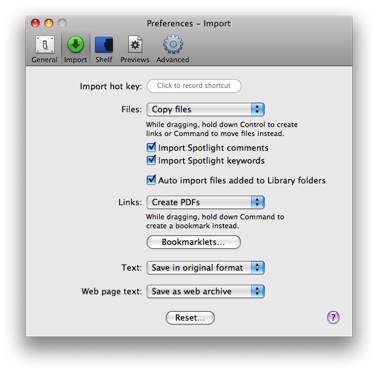 Together can now automatically import files saved in its library folders, meaning you can save files directly to Together’s folders without having to manually import them. This can be enabled by checking “Auto import files added to Library folders” in Import preferences and it’s on by default.
For documents to be imported, you can save them anywhere in Together’s library folders apart from the Support and Trash folders. Together may move the document if it’s in the wrong page (e.g. a text document in the Images folder).
This will probably remove most people’s need for specific watched folders, but that method is still possible and may be useful too.
Import Hot Key
Together 2.1 also adds support for a global import hot key, which can also be set in Together’s Import preferences.
When the hot key is pressed, links or files will be imported according to Together’s Import preferences. This will work with most web browsers, Mail, Microsoft Entourage and NetNewsWire and the Finder.
Bookmarklets
A popular request was for Together to have support for bookmarklets, so web pages can be saved to Together with a single click, so this is now available in 2.1.
You can install the bookmarklets in your browser by clicking the Bookmarklets button in Together’s Import preferences. There are three different bookmarklets to save the current page as a bookmark, web archive or web PDF.